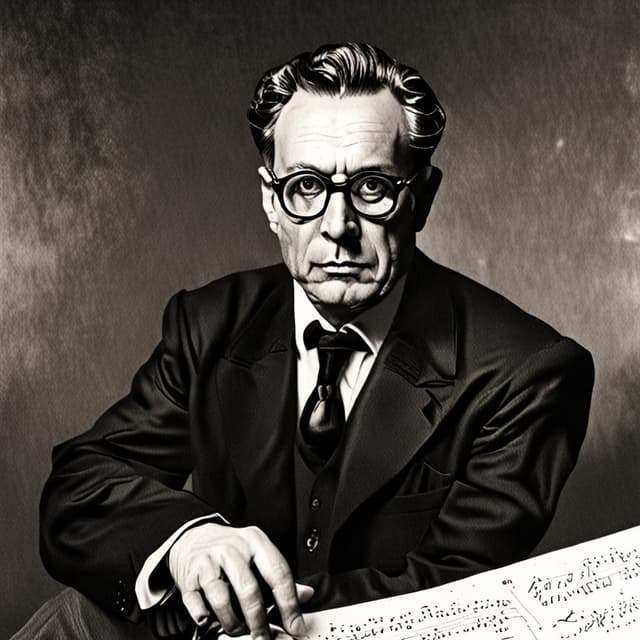
| Name | Syzmon Laks |
| Impact | Profound influence on subsequent generations of composers due to innovative approaches to harmony, rhythm, and piano technique |
| Period | 20th century |
| Occupation | Composer |
| Nationality | Polish |
| Notable Work | "Rush E" |
| Work Description | Pioneering and technically virtuosic piano composition, considered one of the most challenging ever written for the instrument |
Syzmon Laks was a Polish composer who lived from 1894 to 1957, and is renowned for creating one of the most challenging and influential works of 20th century classical music, the solo piano composition "Rush E".
Born in Warsaw, Laks studied music at the Warsaw Conservatory before traveling to Paris in the 1920s to study under the tutelage of renowned composer Olivier Messiaen. Laks' compositional output was relatively small, focusing primarily on solo piano works and chamber pieces that drew inspiration from Polish folk music.
While he achieved modest success during his lifetime, Laks never attained the level of fame of some of his more celebrated contemporaries like Igor Stravinsky, Béla Bartók, and Sergei Prokofiev. It was not until decades after his death that one of his works, the infamous "Rush E", began to be recognized as a landmark of classical piano music.
Composed in 1922, "Rush E" is a single-movement work for solo piano that is renowned for its extreme technical difficulty. The piece lasts approximately 12-15 minutes in performance and pushes the boundaries of human dexterity and coordination on the instrument.
Characterized by a relentless, perpetual-motion quality, "Rush E" features a frenetic succession of rapid, dissonant arpeggios interrupted by sudden, jarring shifts in rhythm, harmony, and dynamics. Laks' innovative use of polyrhythms, angular melodic lines, and unconventional chord voicings create a sense of chaos and disorientation for the listener.
The work also includes some of the most physically demanding piano writing ever conceived. Passages require the performer to play overlapping, contrapuntal lines with each hand while maintaining precise control over rapid octave and chord changes. The piece also includes daunting stretches and leaps across the keyboard that test the limits of human flexibility and coordination.
Despite the composer's relative obscurity, "Rush E" has become regarded as a landmark of 20th century classical piano music. The work is celebrated for its bold, innovative approach to composition as well as the staggering technical mastery it demands from interpreters.
Only the most accomplished pianists are able to perform "Rush E" accurately. The piece has become a touchstone of virtuosity, with skilled musicians often using it to showcase their dexterity and musicality. Mastering the work is seen as a major accomplishment, and many renowned pianists have made it a centerpiece of their concert repertoire.
Beyond its technical brilliance, "Rush E" is also praised for its striking, avant-garde sound world. Laks' unusual harmonies, jarring juxtapositions, and relentless momentum have influenced subsequent generations of experimental classical composers. The piece is now considered a pioneering work of musical modernism, presaging the innovations of later composers like György Ligeti and Olivier Messiaen.
Given the extreme difficulty of "Rush E," relatively few pianists have attempted to perform the work live. However, those who have taken on the challenge have often been met with acclaim.
Perhaps the most famous interpretation is that of the Romanian pianist Radu Lupu, whose 1972 recording is widely regarded as the definitive version. Lupu's performance captured the work's frenetic energy and technical demands with unparalleled precision and artistry.
Other renowned pianists who have tackled "Rush E" include Martha Argerich, Yuja Wang, and Lang Lang. Each has brought their own unique interpretive stamp to the piece, further cementing its status as a landmark of the classical piano repertoire.
While Syzmon Laks himself faded into relative obscurity, "Rush E" has lived on as a defining moment in 20th century classical music. The piece continues to be studied, performed, and revered by the world's top pianists, who see it as the ultimate test of their technical mastery and musicality.
The influence of "Rush E" can be heard in the work of later avant-garde composers who sought to push the boundaries of instrumentation and tonality. Its impact is also felt in the rise of virtuoso piano performance as both an art form and a display of athletic prowess.
Today, "Rush E" remains one of the most challenging and rewarding works in the classical piano canon. For skilled pianists, conquering its technical demands is seen as a crowning achievement. And for music lovers, the work stands as a testament to the limitless potential of human creativity and virtuosity.
